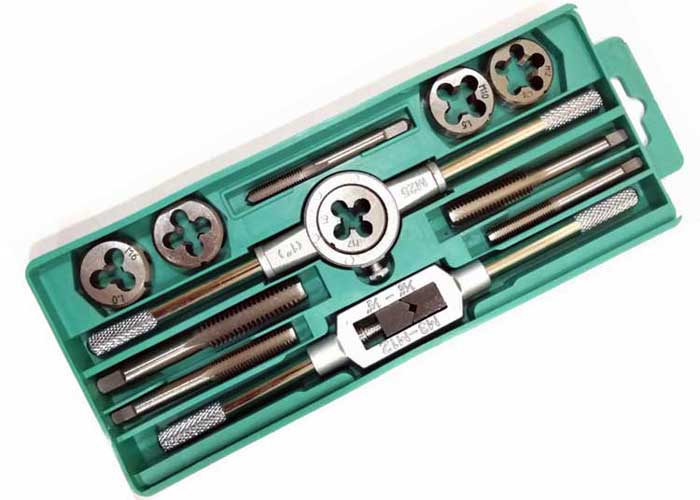
If you’ve ever needed to cut threads on a rod or inside a hole—whether to repair a fastener or create one from scratch—you’ve likely come across the term “tap and die set.”
But what exactly is it? And more importantly, how do you use it effectively in machining, maintenance, or DIY work?
In this guide, we’ll explain what a tap and die set is, how it works, when to use it, and how to choose the right set for your application. Whether you’re a machinist, mechanic, or production buyer, this article will give you the foundation to make smarter tooling decisions.
What Is a Tap and Die Set?
A tap and die set is a combination of tools used to create or repair threads—the spiraled grooves that allow nuts and bolts to fasten tightly.
A tap cuts internal threads (like the inside of a nut or hole).
A die cuts external threads (like the outside of a bolt or shaft).
These tools are typically made from high-speed steel (HSS) or tungsten carbide, depending on the material they’re intended to cut.
Tap and die sets usually include:
Multiple sizes of taps (e.g., M3 to M12 or 1/4" to 1")
Matching dies
Tap wrench and die handle
Thread pitch gauge
Storage case
They are widely used in repair work, custom part fabrication, and low-volume machining.
What Are Taps Used For?
Taps are used to create threaded holes, usually in pre-drilled holes in metal, plastic, or even wood.
There are several common types:
Taper Tap
Has a gentle lead-in
Easy to start by hand
Good for beginners
Plug Tap
Has fewer tapered threads
Used to deepen or finish threads
Common in production work
Bottoming Tap
Threads almost all the way to the bottom of a blind hole
Used after the hole is already started
For CNC or high-performance machining, spiral point and spiral flute taps are used for better chip control and deeper holes.
What Are Dies Used For?
Dies are used to cut male (external) threads, such as those on bolts, studs, or threaded rods.
They also come in a few variations:
Circular Dies
Most common type, used with a die handle
Adjustable types allow minor diameter tuning
Hex Dies
Used with a wrench or socket
Great for quick repairs in the field
Dies can be used for cutting new threads or chasing damaged threads on bolts.
When to Use a Tap and Die Set
Repair stripped threads in holes or on bolts
Create custom fasteners for prototypes or low-volume production
Maintain industrial equipment in the field
Restore threads after welding, cutting, or corrosion
Build or modify machinery with unique thread sizes
If you're working with older equipment, especially from different countries, having both metric and imperial sets can save the day.
How to Choose the Right Tap and Die Set
Here’s what to look for if you’re buying a set:
1. Material of the Tools
HSS (High-Speed Steel): Durable and affordable—good for most metals
Carbon Steel: Suitable for soft materials (not recommended for heavy use)
Carbide or Coated Taps: Best for industrial, high-hardness applications
2. Size Range
Match your needs—if you work in both metric and imperial systems, get a dual-standard set
3. Thread Type
UNC/UNF: Unified thread for American fasteners
Metric: Most common worldwide
BSP/NPT: For pipe threading
4. Accessories
Make sure it comes with tap wrench, die handle, and pitch gauge
A quality storage case keeps everything organized and safe
Tap and Die Maintenance Tips
Always lubricate the tool before cutting threads
Go slow and back off frequently to clear chips
Clean tools after use and store them dry
Inspect for wear—dull taps/dies can cause poor thread quality or breakage
We Supply Professional Tap and Die Sets for Industry and Trade
Our tap and die products include:
HSS and carbide taps and dies for steel, aluminum, stainless steel
Metric and imperial kits for all thread types
Custom kits for OEM customers or industrial resellers
Options with Titanium or AlCrN coatings for extended tool life
Contact us today for product specs, pricing, and sample availability.